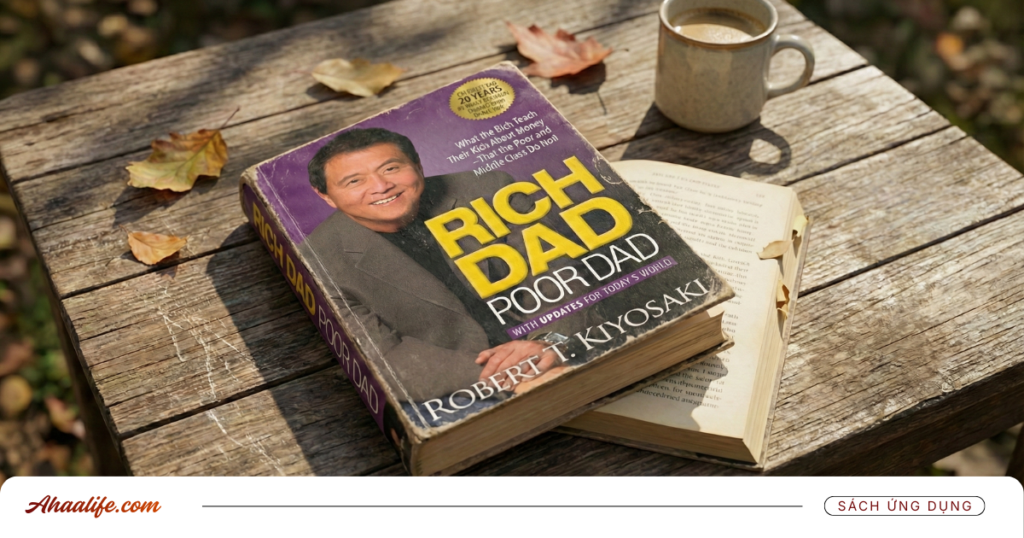
Some books are meant to be read; others are designed to demolish and rebuild your entire existence. For me, Robert Kiyosaki’s Rich Dad Poor Dad wasn’t a dry financial manual. It was a mirror—one that reflected the “delusional security” I had spent years clinging to.
Looking back at the decade-long marathon since I first cracked open that book, I’ve realized one thing: True freedom doesn’t live in bank balance digits. It lives in a cognitive revolution and the painful transition from theory to the grit of real life.
1. The Cognitive Shock: When “Stability” is the Greatest Trap
Before this book, I was a “devout follower” of the system: clock in, clock out, collect a paycheck, and call it success. I genuinely believed a stable job was the ultimate safe harbor.
Then the Cashflow Quadrant appeared like a slap in the face, asking: “Where do you actually stand in the E – S – B – I matrix?”
I realized I was suffocating in the E (Employee) quadrant. Robert said something that sent a chill down my spine: “When you believe in stability, that is when you are at the greatest risk.” Why? Because that stability isn’t yours. It belongs to your boss, the market volatility, and an economy you have zero control over. That was my wake-up call: adapt or be swept away.
2. Phase 1: Re-coding the Brain – Assets vs. Liabilities
The first step wasn’t about “making more”; it was about “thinking better.” I began scrutinizing every cent through a single, brutal lens: Is this an Asset or a Liability?
It’s an uncomfortable war. You find yourself pausing for a few seconds before every purchase—a new gadget, a brand-name shirt—and asking: “Will this put money into my pocket, or just feed my ego?” It’s a battle between vanity and long-term sovereignty. I started disciplining my cash flow, treating every dollar as a soldier in my private army of freedom. It was a small shift, but it was the foundation for a ship destined for the open sea.
3. Phase 2: The “Lessons in Blood” – Reality Hits Hard
This is the part the books don’t tell you about. I didn’t choose a straight line; I chose a chaotic, head-first plunge.
- From E to S to B – The Ego Crash: I started a business fueled by raw passion and a massive ego. And then… I hit the floor. Hard. I lacked market intuition, was blind to operations, and pathetic at risk management. I learned the hard way: escaping the rat race requires more than “wanting it”—it requires a combat-ready skill set and nerves of steel.
- From E to I – The High Tuition of Greed: Moving into the I (Investor) quadrant requires a cold heart and extreme discipline. I once lost nearly everything because I invested on emotion—the classic greed of a total amateur.
But from those ashes, I forged the “Fuel Strategy.” I accepted staying in the E (Employee) group to generate steady cash flow—my “fuel” for experiments in the I group. By day, I worked the office; by night, I was a diligent apprentice of the market. The 8-hour workday no longer felt like a prison because I knew I was using it to buy back my life.
4. Overcoming the Invisible Walls
The tallest wall wasn’t a lack of capital; it was loneliness. When you shift your value system, you drift away from the mainstream. There were long nights of wondering if I was losing my mind, and countless “disappointed” head-shakes from family as I bypassed “stable” opportunities. I realized: “Whoever chooses to swim against the current must accept walking alone for a while.” But as soon as I was truly ready to learn, the real-world “Rich Dads” appeared. I found my tribe—people on the same frequency who taught me that financial intelligence is far more valuable than the currency itself. When the pressure to “make money” transformed into the joy of “solving problems,” my life finally turned a new leaf.
5. Conclusion: Freedom is a Choice, Not a Number
After 10 years, I don’t call myself a tycoon, but I have crossed the threshold into the I quadrant. The path is clear, the mindset is hardened, and every step I take is now intentional.
Ahaalife.com isn’t some “get rich quick” portal. It’s the diary of a marathon—the story of how a person terrified of instability became a self-reliant nomad, mastering the financial game through discipline and tiny, daily habits.
Financial freedom isn’t for resting. It’s so you have the absolute right to say “No” to what you hate and “Yes” to what you love. This journey isn’t for the sprinters; it’s for the persistent.
Are you ready to take the first stride? To hell with the rest, just go and stay disciplined.