Stop for exactly three seconds, don’t think, and write down the first number that jumps into your head:
A bat and a ball cost $1.10 together. The bat costs $1.00 more than the ball. How much does the ball cost?
If the number that flashed up was 10 cents, congratulations – you’ve joined the vast majority of humanity, including more than 50% of students at Harvard, MIT and Princeton, who got it wrong in exactly the same way.
The correct answer is 5 cents. If the ball costs 5 cents, the bat – a dollar more – costs $1.05, and together they come to exactly $1.10.
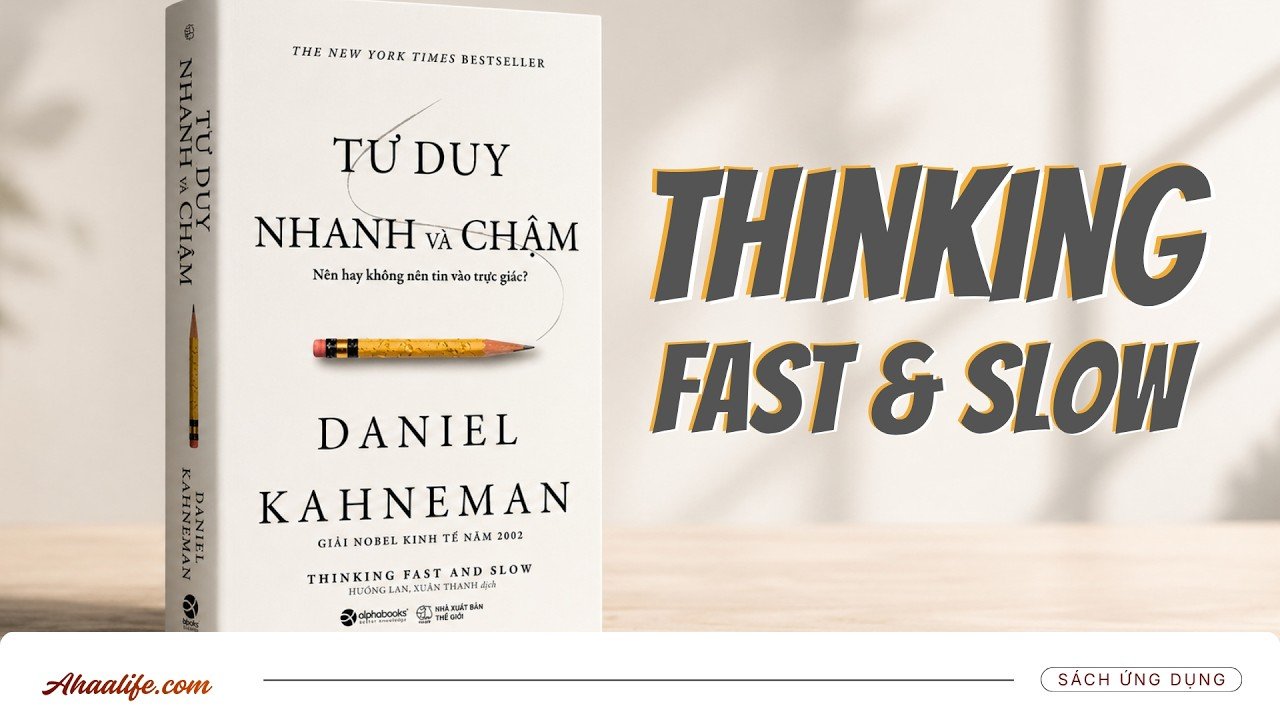
The interesting question isn’t whether you were right or wrong. It’s this: why does a piece of first-grade arithmetic, simple enough for a child, fool some of the sharpest minds on the planet? Daniel Kahneman spent his life answering that question.
A psychologist who won the Nobel Prize in Economics
There’s a delicious paradox here. Kahneman was a pure psychologist with no formal training in economics whatsoever. And yet in 2002, the Royal Swedish Academy of Sciences awarded him the Nobel Prize in Economic Sciences.
Before him, traditional economics ran on one core assumption: that human beings are rational economic creatures who always weigh their options to optimize their own wallets.
“We are not as rational as we believe. In reality, we are creatures full of biases, easily manipulated, and constantly making decisions through emotional shortcuts.” – Daniel Kahneman
Kahneman brought the findings of psychology into economics and demolished that assumption. He proved that when facing risk, money and the big choices of a life, we behave with startling emotion. A psychologist winning the Nobel in Economics was a blunt declaration: if you want to understand management, finance, or any major human decision, you first have to understand how the brain actually works.
Two systems of thought: a trap that spares no one
In Thinking, Fast and Slow, Kahneman divides the way the brain processes information into two characters.
System 1 – autopilot. Instantaneous, instinctive, emotional, built on old experience. When you swerve around an obstacle on the road, read anger on someone’s face, or glance at a road sign while driving – that’s System 1. It handles almost everything you do in a day, effortlessly.
System 2 – the pilot flying by hand. Logical, calculating, demanding deep concentration. When you multiply 17 by 24, hunt for your car in a vast parking lot, or fill out a tax form – you have no choice but to switch it on.
The trap is that System 2 is fundamentally lazy. The brain accounts for 2% of body weight but consumes 20% of the body’s energy. To economize, it delegates almost everything to System 1.
- Autopilot mode
- Speed: instantaneous
- Emotional, instinctive
- Almost no energy cost
- Flying the plane by hand
- Speed: slow, deliberate
- Logical, analytical, data-driven
- Extremely energy-hungry
Because of that mechanism, the intuition trap spares no one. Many people believe credentials and titles make them immune to error. They don’t. An expert’s overconfidence in their own experience is often the most fertile ground for System 1 to run wild – they judge by feeling and never notice they’re doing it.
The five classic studies below show just how thoroughly System 1 quietly governs our lives.
1. The bat and the ball – the laziness of the intelligent
The number 10 cents appears instantly because it feels neat, tidy, satisfying. System 1 loves fluency. Rather than run a quick check – which is System 2’s job – the brain simply accepts the wrong answer, because it is too lazy to move.
This scene repeats itself every day at work. A revenue report that sounds right, a business plan presented smoothly, and we nod it through.
Slow down one step: pause for five seconds, put the calculation on paper, or ask one challenging question. Those five seconds save you from errors that look trivial and cost a great deal.
2. Linda – the probability trap of emotion
Kahneman describes Linda: 31, single, bright, deeply concerned as a student with social justice and anti-nuclear causes. Which is more likely?
(A) Linda is a bank teller.
(B) Linda is a bank teller and an active feminist.
Nearly 90% of participants chose B. Mathematically that is impossible: B is a subset of A, so A is always greater than or equal to B. But System 1 was seduced by a story that was too coherent, too satisfying, too Linda – and it threw basic probability out the window.
You meet Linda again every time you hire someone or choose a partner. A glossy résumé, an inspiring self-introduction, and System 1 concludes at once: “Anyone who speaks this well must deliver.”
Slow down one step: separate emotion from data. Look at measurable performance, work history, actual outcomes – not the story being told.
3. The judges’ dice – the manipulation of noise
A startling study on experienced German judges: before sentencing a shoplifter, they were asked to roll a die that had been rigged to land on either 3 or 9. Judges who rolled a 9 handed down an average sentence of 8 months. Judges who rolled a 3 gave 5 months. A completely random number shaped the judgment of masters of the law.
That is the classic anchoring play in retail. A shirt tagged “Was $200 – now 75% off, $50.” The $200 is the anchor driven into your System 1, convincing you that you’ve scored a bargain, when the shirt may honestly be worth $30.
Slow down one step: pull the anchor out with a single question. “If that original number didn’t exist, would this thing really be worth that much to me?”
4. The availability heuristic – fear of flying and the trap of buying the top
We judge how dangerous something is by how easily we can recall an example of it. The media reports relentlessly on plane crashes and terrorism, so System 1 stores those vivid, emotional images. Most people believe accidents kill more people than strokes. The truth runs the other way, and by a wide margin – strokes just rarely make the front page.
This same mechanism is the root of FOMO in investing. When property or the stock market is at the peak of a mania, every conversation you overhear is about getting rich fast. The information is so easy to access that System 1 concludes “this is a sure thing,” and urges you to pour in everything you have, right before the bubble bursts.
Slow down one step: step back from the crowd and go find the macro reports and the historical data on economic cycles. Dry numbers protect you better than noise does.
5. The eyes above the honesty box – the subconscious quietly steered
In one office, a picture of a pair of eyes staring straight ahead was posted above the honesty box for tea and coffee. Contributions rose to nearly three times the level of the week with a picture of flowers. Not one employee knew their behavior had just been changed. Their System 1 had read those eyes as a signal of social observation and switched on a sense of accountability beneath awareness.
Your environment primes your thinking every minute. If the first thing you do on waking is scroll a feed full of outrage and negativity, System 1 gets loaded with a dark filter. All day you look at your colleagues and your partner through irritation and judgment, and you never understand why.
Slow down one step: consciously design the environment around you. Curate what you consume, read books worth the hours, sit beside people who lift you. You’re planting seeds for System 1, and you will live a different life.
A personal view: building a brake for your life
After years of work, of running large projects, of meeting people from every walk of life, I have to admit plainly: I am still a frequent victim of System 1.
I’ve closed deals too fast simply because the person across the table spoke my language. I’ve bought expensive gadgets that sat untouched for a year, primed by a handful of emotional review videos.
The price I paid – in cash, and in relationships – is what pushed me into a serious revolution in thinking: patiently shifting, day by day, from System 1 to System 2. The goal isn’t to turn myself into a cold calculating machine. The goal is to have nothing to regret.

Three practices I’ve tested and found effective:
Build a deliberate delay. Before any high-stakes decision, or in any moment of surging emotion, count to ten or sleep on it. That gap is when System 1 cools and the System 2 pilot has time to take the controls.
Argue against yourself. When you’re in love with a plan, force your brain to answer three questions: What if every assumption I’m making is wrong? What data proves this, or am I just feeling it? Am I being manipulated by an anchor or by availability?
Think on paper. System 2 hates abstract reasoning in the head but is remarkably sharp with visual structure. Facing something complex, take a sheet of paper, draw a line down the middle, benefits on one side and risks on the other, or write out the actual numbers. The act of putting pen to paper forces the brain off autopilot.
Closing
System 1 is a priceless gift of evolution. It let our ancestors react in a flash to the claws of a predator and survive. But in a world dense with sophisticated traps from media, marketing and financial volatility, relying on System 1 alone is strategic suicide.
Slowing down is not sluggishness or weakness. It is the wise step back of someone who owns himself, a deliberate pause to switch on the headlights of reason.
Start building your mental brake today, so that every step ahead is steady, clear-eyed, and never followed by two words: “If only…”
Ahaalife – A life worth living.