The deepest lessons I have drawn from a book – and how they changed the way I live.
The first time I heard Sadhguru say “Death is the most beautiful thing about life,” I stopped cold. The words sounded like a contradiction. But they stayed with me – and I kept turning them over, again and again.
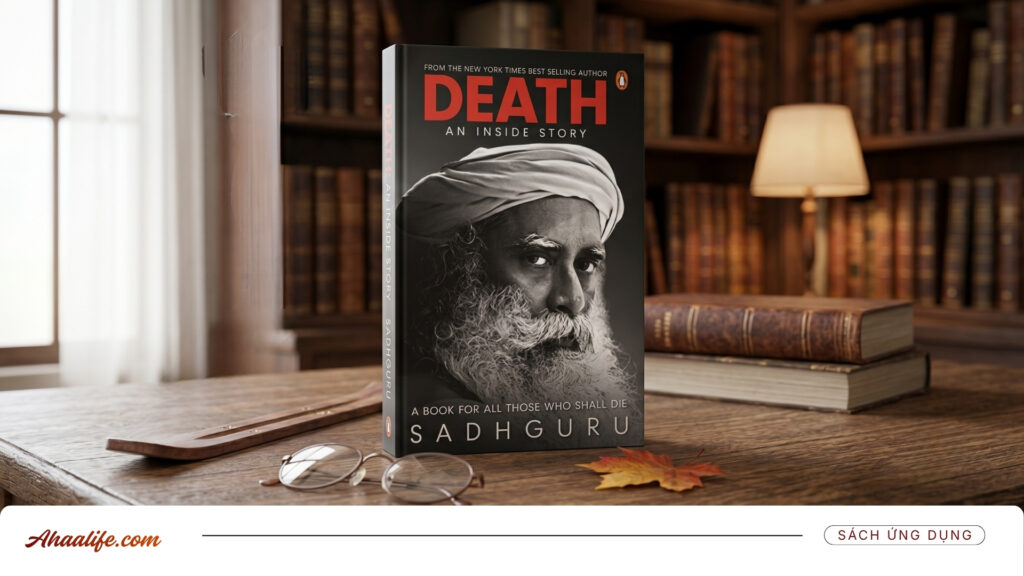
It wasn’t until I finished his book Death that I truly understood. This is not a book about dying. It is a book about how to live – fully, deeply, without the slow leak of days we barely notice passing.
The book was written just before COVID-19 arrived – before the whole world was suddenly forced to confront how fragile a life can be. Page by page, Sadhguru doesn’t frighten or despair. He quietly uncovers the truth most of us work hard to forget: one day, we will die. And it is precisely because of that – because we know it in our bones – that we can finally learn to live each moment as if it actually matters.
What follows are the most important things I took from this book, and the specific ways they have changed how I move through the world.
Death Is Not an Ending – It Is a Beautiful Part of Life
Sadhguru writes: “Death is only the fiction of the ignorant. Life simply moves from one dimension of existence to another.”
He compares life and death to breathing – inhaling is living, exhaling is dying. Without the exhale, the next breath cannot come.
Zen master Thich Nhat Hanh teaches something that echoes this perfectly: no birth, no death – only transformation. A cloud never dies. It becomes rain, becomes river, becomes tea in a cup.
Reading those lines, I realized I had always feared death because I thought of it as a full stop. Now I understand it as a transition. That shift alone has made the fear much lighter.
Osho adds another layer: death is not the opposite of life, but its highest point – not an accident that happens to life, but something that grows from the very center of it, ripening until it peaks. Seen that way, death becomes something expansive. Not darkness, but the ultimate release after a life fully lived.
This understanding helped me see that fear of death is almost always rooted in clinging – to appearances, to a fixed sense of self. When that clinging loosens, the current of life moving through its many forms becomes visible. And the fear, gradually, dissolves.
I Used to Live as Though I Would Never Die
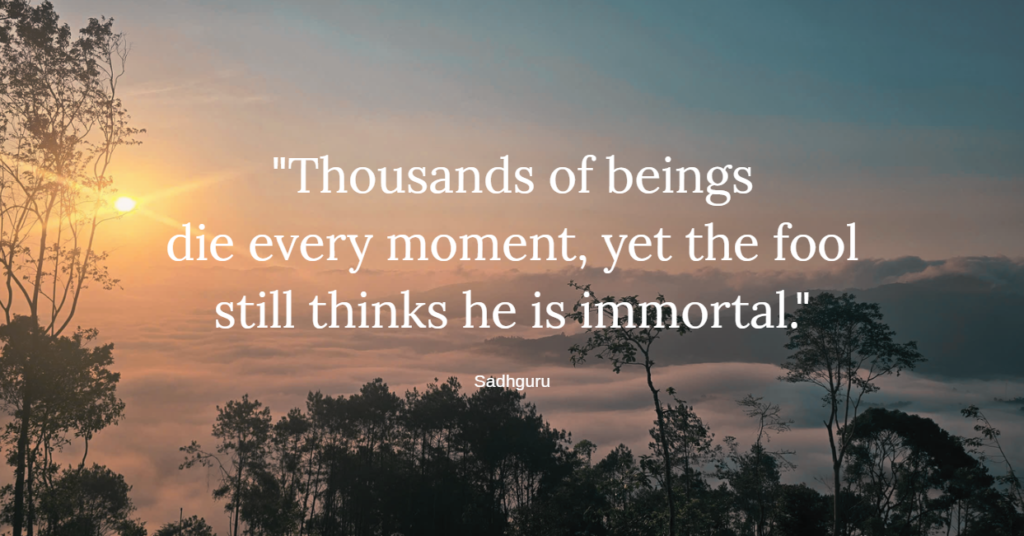
Sadhguru writes: “Thousands of beings die every moment, yet the fool still thinks he is immortal and refuses to prepare for death.”
That line felt like a hand reaching through the page to shake me.
I recognized myself immediately. The procrastination. The irritability with the people closest to me. The days filled with noise that meant nothing – because I assumed time was something I had in endless supply. The pandemic stripped that assumption bare. People were gone overnight, leaving behind all the things they never got around to saying.
That was when I started to change. I stopped allowing days to simply pass. Every morning I practice gratitude – for what I have, not what I lack. I have learned to release petty arguments, because I now understand that today might genuinely be the last day we have together.
Haemin Sunim reminds us that everything is impermanent, and that impermanence is an invitation – to slow down, to be more fully present in whatever is actually happening right now. He writes: stop lamenting that the world has changed, stop resenting that people have changed. Measuring the present against memories of the past only produces sadness. Whether we like it or not, change is unavoidable.
That reminder deepens the lesson from Sadhguru. Accepting death means accepting that everything shifts. Instead of resisting, I am learning to move with it – to treasure what is here before it transforms into something else.
Awareness of Death Taught Me to Treasure Being Alive
The passage that moved me most: when we carry an awareness of our mortality, we begin to “walk gently on this planet.”
I took that seriously. Every morning before the day takes over, I sit for a few minutes with a single thought: “I am still here. This is one more day I have been given.” Then I actually listen to the birds. I feel the ground beneath each step. I watch my own breath moving in and out. This is how I charge myself for the day ahead.
A story shared by Vietnamese meditation teacher Thich Minh Niem brought this even closer. A patient in the final stage of cancer was guided by the teacher with these words: “Consider yourself already dead. Everything in this life is finished. Now there is only rest – and observing.” She practiced. She watched life slowly. She listened to the wind moving through the trees outside her window. She felt each footstep touching the earth.
After three days, she wept – because she realized how many extraordinary things she had been walking past without ever seeing.
I recognized that in myself too. I used to live without truly living – eyes open but not seeing, ears open but not hearing. Now, after sitting each morning with the fragility of existence, I take time for brief meditation, or simply breathe deeply and feel where I am. That quality of presence makes ordinary days feel sacred. The small anxieties stop weighing so much.
Haemin Sunim puts it simply: when the mind rests, the world rests too. He teaches that slowing down to observe thoughts and emotions without judgment is its own practice, because everything – like clouds – is passing. Negative feelings come, and they go. The open sky remains.
Bringing these teachings together, I have learned to turn the awareness of death into something that energizes rather than diminishes. Mornings that begin with that awareness become mornings where the ordinary feels extraordinary.
Understanding Death Made Me More Generous Toward Others
One of the deepest changes in me has been in my capacity for compassion. When I genuinely accept that everyone will die, holding onto resentment starts to feel absurd.
I have learned to forgive faster – to not let bitterness settle in and stay. Sadhguru is clear that releasing attachment is the foundation of both living well and dying peacefully. I apply this with a single question I ask myself whenever anger rises toward someone: “If one of us were gone tomorrow, would I still want to hold onto this?” That question almost always dissolves the anger before it can harden.
Osho observed that accepting death creates a natural distance from the anxieties of daily life – all the friction and irritation begin to recede. I understand this now in a way I couldn’t before. Resentment is simply the ego gripping a wound. When I see everyone as a fellow traveler on the same journey toward death, something like tenderness arises on its own.
I have started listening more. Judging less. Saying what I feel for the people I love – not waiting for a special occasion that might never come.
Haemin Sunim speaks about loving each other’s ordinariness: I love your ordinariness because I am ordinary too – every one of us is. Fame and wealth change none of it. Everyone faces loneliness. Everyone fears death. That shared condition closes the distance between people. It has made me want to live more openly, with more genuine appreciation for the relationships around me.
How You Live Is How You Will Die
The lesson that has stayed with me most completely: the quality of your death depends on the quality of your life.
A life lived in craving and conflict makes for a heavy departure. A life lived with awareness and lightness – that can end gently, even gracefully, the way the old teachers seemed to go.
Osho states it plainly: the art of living beautifully and the art of dying beautifully are one and the same art. Only when we have truly lived can we depart in a way that feels like completion rather than interruption. Let life be as beautiful as summer flowers, and death as beautiful as autumn leaves.
I don’t see preparing for death as pessimism. To me it is the most honest and responsible way to live. Daily mindfulness. Meditation. Keeping the interior of my life lighter than it was before. Not to wait for death – but so that when it comes, I can meet it with some measure of peace. That inner foundation is what I am building, day by day.
The Peace That Came – the Greatest Gift This Book Gave Me
Because of this book, death no longer feels like something to dread. I have started to see it as the most sacred dimension of life – not its opposite, but its fullness.
The peace that came from this isn’t something I’m waiting to feel at the end. It is already here, woven into ordinary days. A quieter calm underneath everything. Less anxiety. A deeper, more genuine gratitude for every day I am still alive.
Thich Nhat Hanh teaches that our true nature is the nature of no birth and no death – and that only when we touch that nature can we move beyond the fear of non-existence. Mindfulness practice is the way I reach toward that nature in daily life, turning what used to be fear into something closer to wonder.
Closing
Reading Death by Sadhguru is one of the most significant experiences of my recent years. The book didn’t just help me understand death more clearly. It taught me to love life more honestly and more deeply than I ever had before.
What I carry from it: only when we are willing to look directly at death – with openness, with gratitude – do we truly learn how to live. And when that happens, we don’t just live well. We become capable of departing in peace.
The voices of Sadhguru, Osho, Haemin Sunim, Thich Nhat Hanh, and Thich Minh Niem have each enriched this journey in their own way. Osho illuminated death as a peak, an ultimate release. Haemin Sunim called me back to slowness and presence within impermanence. Thich Nhat Hanh opened the door to something beyond birth and death altogether.
Together they carry a single message: death is not an enemy. It is the companion that teaches us to live more fully and give more generously. Life is short but it runs deep. And when we learn to hold death as a beautiful part of it, every moment becomes something worth being present for.
Ahaalife – A life worth living.