Estimated reading time: 7 minutes | Topic: Personal Development, Applied Philosophy
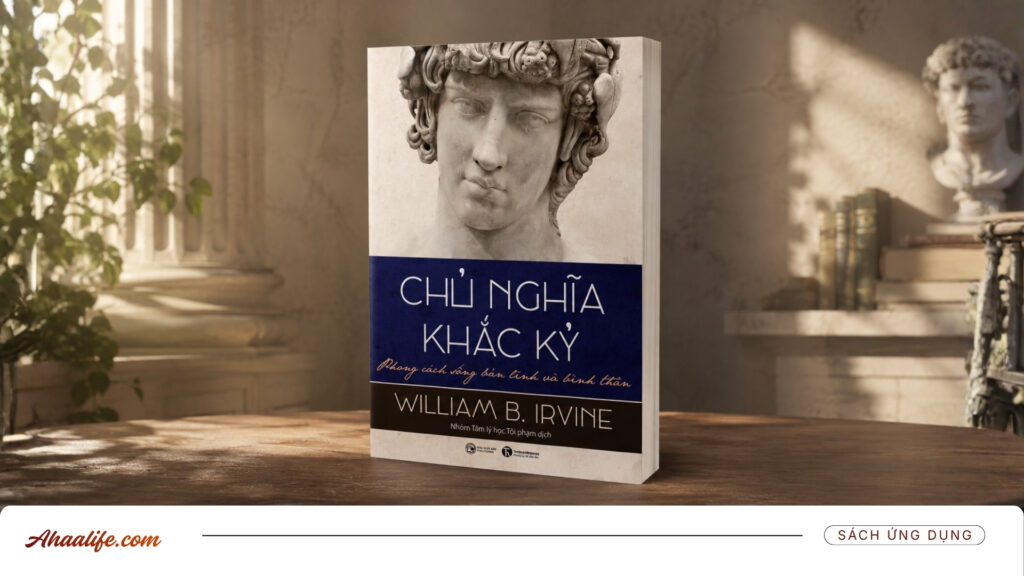
If you are holding a book on Stoicism in your hand and hesitating over whether words written thousands of years ago by ancient Roman philosophers can help with a modern life flooded with deadlines, financial stress, and complex relationships, my most sincere advice to you is: Open it and read it right now.
Do not hesitate; the book contains a minimalist “operating system” for the mind, a practical manual of action so powerful that it can completely transform how you view the world and confront yourself.
I write these lines not from the perspective of a philosophy scholar, but as someone who has lived, stumbled, and spent half a lifetime struggling in the vortex of anxiety. For me, Stoicism has truly integrated into every breath, every run, every financial decision, and every conversation with my employees. It is the compass that guided me out of the swamp of exhaustion to step onto a journey of peaceful tranquility. And I believe that you, too, can start a life worth living right from this very book.
PART I: OVERCOMING FEAR
Stepping past the age of 40, looking back at the long road behind with more than a decade of hustling in high-pressure environments, I suddenly realized a truth: It took me nearly half a lifetime to understand the nature of peace.
Previously, like many busy adults, I lived in a constant state of chronic stress. I worried about metrics, worried about economic fluctuations, got irritated by the behavior of those around me, and feared the uncertain risks of the future.
I spent too much time and mental energy worrying about and trying to manage things completely out of my hands. The consequence? A horrific depletion of mental energy. Countless sleepless nights with racing thoughts, a sense of helplessness, and exhausting fatigue, even though I hadn’t done any heavy physical labor. I had turned myself into a slave to external circumstances.
It was during this phase, when my mental energy hit rock bottom, that my fateful encounter with “Stoicism” occurred. The book appeared exactly when I needed it most. Turning its pages, I didn’t find the empty encouragements like “everything will be fine” of toxic positivity. Instead, I found a stark, naked sobriety. The book didn’t leave any extra theoretical jargon in my head; rather, it was immediately put into deep “practical application.” I began to change how I operated my life based on the three core pillars below.
PART II: OPERATING LIFE THROUGH THREE STOIC PILLARS
Pillar 1: The Dichotomy of Control & Amor Fati
The first cornerstone that completely overturned my thinking was the Circle of Control.
“Some things are in our control and others not.”
— Epictetus
The Stoics divide the world into two distinct parts:
- The area out of our control: The weather, the economy, pandemics, the past, the future, and especially the thoughts and actions of others.
- The area truly within our control: Only our thoughts, reactions, efforts, and our own moral values.
Human suffering and exhaustion are born when people direct their energy toward changing things in the uncontrollable zone while neglecting what they can control.
Thanks to the book, I suddenly recognized the mistake of my first half of life. I stopped wasting energy on immutable things and shifted my entire energy funnel to the “controllable” zone. I began redesigning my life around realistic goals where I decide the outcome through daily action:
- On finance: Instead of sitting around worrying about economic recessions or market volatility (things I cannot control), I focus 100% on learning, upgrading my investment mindset, and equipping myself with knowledge to actively improve my future financial health.
- On physical fitness: I establish personal discipline by running regularly every day. When I lace up my shoes and head out, with no smart watch measuring my stats, I only focus on listening to my breath, feeling each stride, and connecting deeply with my body. That is a discipline I completely master.
- On life experiences: I utilize my time to learn a new language, read books, and listen to podcasts to expand my mind and worldview.
When you cultivate this, you will naturally understand the concept of Amor Fati – loving one’s fate. Stoics do not resign themselves to adversity; they embrace it. Epictetus taught:
“Seek not that the things which happen should happen as you wish; but wish the things which happen to be as they are.”
Every event that occurs is no longer a stroke of bad luck, but a situational exercise, a fuel to make the fire of resilience inside me burn brighter. My success, balance, and stability today do not come from the luck of a smooth life, but from the fruits of focusing entirely on what I can truly control.
Pillar 2: Returning Things to Their True Stoic and Buddhist Nature
The second pillar, which saved many of my social relationships and brought peace to my management work, is practicing viewing things through an objective lens. In his handbook, Epictetus points out:
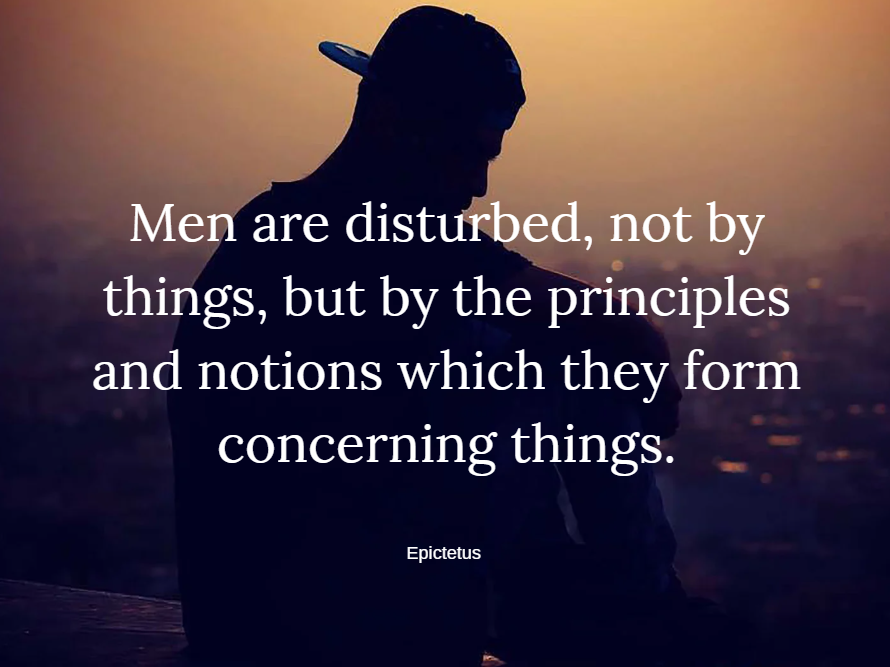
“Men are disturbed, not by things, but by the principles and notions which they form concerning things.”
The nature of everything that happens in the world is completely neutral—neither good nor bad. It is our ego, expectations, and emotional labels that transform events into tragedies. This philosophy shares a striking similarity with Buddhist thought: “The mind is at peace when it perceives things as they are.” When we look at all things with a truthful, unembellished gaze—without interpreting them through the lens of our own ego—suffering naturally dissolves.
I vividly remember a real-world story from my work. Once, a junior employee gave me some very frank feedback about a point they felt was inappropriate in how I made decisions. At that time, because of my ego as someone with “many years of experience” and because I had high expectations for this employee, I let negative thoughts consume my mind. Questions constantly swirled in my head: “Why did this person behave like that?”, “How dare they speak to me like that in front of everyone?”, “Do they not respect me?” I brought that resentment home and spent several sleepless nights agonizing over it.
Looking back now, I find those thoughts quite “bizarre,” but they are the clearest proof of how our minds construct our own suffering. When I understood Stoicism and separated prejudice from reality, I looked straight at the essence of the matter: It was simply a constructive feedback conversation, entirely normal and necessary in the workplace. The employee was just doing their job well.
My mind deserved to be at peace during those days instead of suffering from wounded pride. Instead of holding onto resentment, the right and most positive action I should have taken (and could completely control) was to send a sincere thank you to that employee for their courage and honesty. When you know how to return things to their objective nature, you will lead with clarity, not with vulnerability.
Pillar 3: Preparing for the Worst to Attain Absolute Happiness
This is perhaps the most fundamental part, where Stoic philosophy transforms into a lifestyle of absolute freedom and liberation. Stoics often practice two psychological exercises: Visualizing the worst-case scenario (Premeditatio Malorum) and Remembering that we must die (Memento Mori). They do not look at life through rose-colored glasses; they look straight at death and loss to find the ultimate value of living.
From these two exercises, I have developed an unwavering motto for myself:
“Hope for the best, prepare for the worst”
At work, employees often come to me with philosophical questions like: “Sir, when we don’t have much money or time, how can we be happy?” My answer is always consistent, stemming from my own experience and how I run my life:
“I am always prepared for the possibility that tomorrow I might have nothing. My house, car, and accumulated assets could vanish in an instant, or tomorrow could be my last day breathing on this earth. I imagine waking up tomorrow with only a pair of shorts and a pair of flip-flops to my name—and I assure you, I would still be happy.
Why? Because I know I still have a clear mind. I will calmly sit down, grab a pen, write a plan of what needs to be done for the next day, and just keep moving forward. Capturing happiness must be that simple for us to achieve absolute fulfillment. But if I wake up tomorrow and life has gifted me more than just a pair of shorts and flip-flops—I still have a roof over my head, food to eat, and my family by my side—then without a doubt, I am already incredibly happy!”
Defining happiness in such a minimalist way makes us invincible to adversity. When you are no longer afraid of loss, you live an incredibly generous and magnanimous life.
A deep awareness of death (Memento Mori) does not make me gloomy; on the contrary, it makes me find everything around me interesting and worth experiencing. We do not have much time on this planet. Everyone eventually has to say goodbye to the earth, both those who love us and those who dislike us.
When we understand this finiteness, we automatically let go of petty details and unnecessary arguments. You will no longer have time to hold grudges, to prove yourself right and others wrong, or to harbor resentment. You will cherish every moment of today and be more forgiving of others’ mistakes, knowing that this moment is unique.
PART III: STARTING A LIFE WORTH LIVING
Looking back at the journey I’ve traveled, I realize Stoicism is truly a priceless gift that life has bestowed. This book did not turn me into an ivory-tower philosopher judging the world, but it has molded me into a grounded person, a son, a father, and a husband who knows how to cherish the present.
The world outside is always full of fluctuations beyond our control. Markets can crash, others can misunderstand you, and the most perfect plans can fall apart at the last minute. But there is one thing no one, no force on earth, can strip away from you: The right to choose your own reaction.
If you are feeling exhausted, lost, or overwhelmed by the anxieties of modern life, I once again encourage you to find and read a book on Stoicism. Do not read it as an obligation; read it as an invitation to unshackle your own mind.
Start with the smallest things:
- Clearly define the boundaries of your control every morning.
- Learn to see things exactly as they are.
- Prepare yourself to be so free that even if you are left with nothing but a pair of shorts and flip-flops, you can still smile and welcome the new day.
That is not resignation; it is the pinnacle of freedom and tranquility. A life worth living is waiting for you to unfold, right from this page.