Most of us spend our entire lives trapped inside a loop: rush to work in the morning, drag ourselves home in the evening, repeat until retirement. But have you ever stopped mid-loop and asked yourself – is there a different blueprint for this life?
I used to live that exact loop. Clock in. Get paid. Spend. Repeat. I wasn’t broke, but I wasn’t free either. Every month, I sold eight hours a day in exchange for a number in my bank account, then used that number to buy back small comforts for the eight hours I’d lost. I kept running that loop and never found the exit.
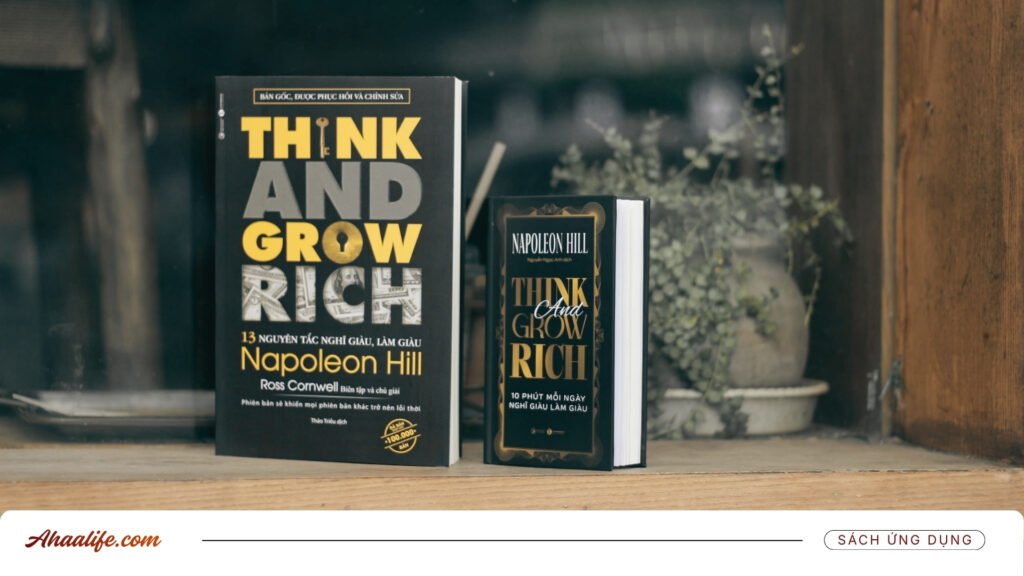
Until I picked up Think and Grow Rich by Napoleon Hill. A book written nearly a century ago, yet when I read it, I felt like Hill was sitting across from me, looking me straight in the eye, and asking: “Are you living – or just existing?”
That question woke me up. And five core messages from this book helped me go from someone who merely worked a desk job to someone who deliberately designed a life worth living.
Desire – The Fire No One Can Blow Out
Napoleon Hill opens his book with a word that everyone uses but few truly understand: desire.
Most of us have “wishes.” We wish to be rich. We wish to be healthy. We wish to be free. But wishes are like small candles – they burn for a while and die at the first gust of wind. Desire is different. Desire is a furnace. Wind blows in, it burns harder. Hill writes that desire is the starting point of all achievement, and that a weak desire produces equally weak results.
Before reading this book, all I thought about was showing up to work and collecting a paycheck. But when I asked myself “what do I truly crave?” – not “want,” but crave, the kind that keeps you up at night – everything started to shift.
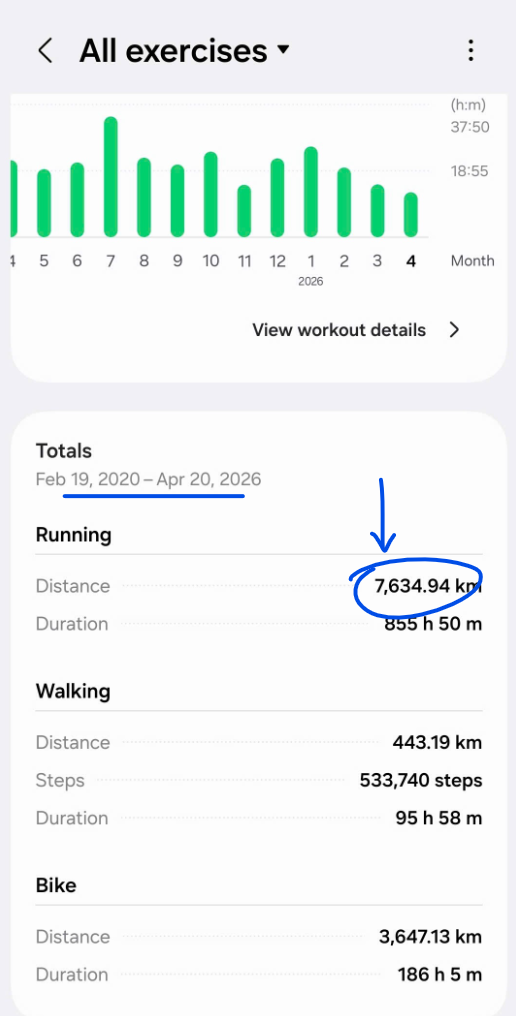
When it came to health, I stopped settling for “staying in shape.” I craved peak mental clarity – the feeling of stepping out of bed at five in the morning with a mind as sharp as a freshly honed blade. While the city was still half-asleep, my running shoes and I had already sealed the first deal of the day: defeating my own laziness. Not the kind of running where you go hard for a week and quit. I’m talking about a minimum of 1,000 kilometers every single year. To date, I’ve logged over 7,000 km – roughly the distance from Saigon to Europe, if you trace it on a map. But the number isn’t the point. What matters is that every step on that road taught me a lesson no classroom ever did: discipline is not a chain – it’s a pair of wings.
Then came giving. I once thought donating 1,000 books to my community was a pipe dream. A thousand books! Who does that? But desire has a strange quality: it doesn’t need you to see the entire road. It only needs you to take the first step. And I took it. Over 300 books have been given away so far – a third of the journey. I haven’t reached the finish line, but every time a book leaves my hands, I feel something money can’t buy: the unmistakable sense that the flow of value is moving in the right direction.
Andrew Carnegie – the legendary steel magnate featured in the book – once said that he spent the first half of his life accumulating wealth, and the second half giving it all away. Real desire never points only inward. It always has a share reserved for others.
Faith – When You Believe, Your Eyes Open
Let’s say you’ve got the desire. The fire is burning. But then reality hits you with a bucket of cold water. Beautiful plans crash into harsh circumstances. People around you doubt. Results are nowhere in sight, yet exhaustion is already everywhere. That’s when most people quit – and that’s exactly when faith shows up.
Napoleon Hill calls faith a state of mind that can be created – not something you’re born with – and the only antidote to failure. I want to pause on the phrase “can be created” for a moment. Many people think faith is something mystical, as if you need to be “enlightened” or “awakened.” It’s not. Hill is very clear: faith is built through repetition. Tell yourself something long enough, act on it consistently enough, and gradually it becomes part of the operating system inside your mind.
Before reading this book, I didn’t believe I could live without depending on a fixed job. The idea of “financial freedom” sounded like another internet slogan – inspiring on screen, irrelevant in real life. But as my thinking shifted, I started meeting – quite naturally – people who were living the very life I thought only existed in books. They traveled on weekdays while everyone else was stuck in traffic heading to work. They stayed home with family on holidays while the crowds fought for space at airports. They weren’t rich in the flashy way – no supercars, no mansions – but they owned something that billions can’t always buy: time.
Once I believed I could build passive income, I began seeing opportunities that had been invisible before. Not because the opportunities were new – they’d always been there – but because belief had changed the filter in my head. It’s like deciding to buy a red car and suddenly noticing red cars everywhere. The number of red cars didn’t increase. Your filter changed.
Mahatma Gandhi once said – and Hill quotes him in the book – that when you believe you can do something, you develop the ability to do it, even if you didn’t have that ability at the start. I’ve found this to be terrifyingly accurate.
But remember: faith is not sitting still and repeating “I will succeed.” Faith is acting every single day – however small the step – in the direction you want to go, trusting that each step is bringing you closer, even when you can’t see the destination yet. No glamour. No miracles. Just quiet consistency, day after day.
The Mastermind – The Energy of Resonance
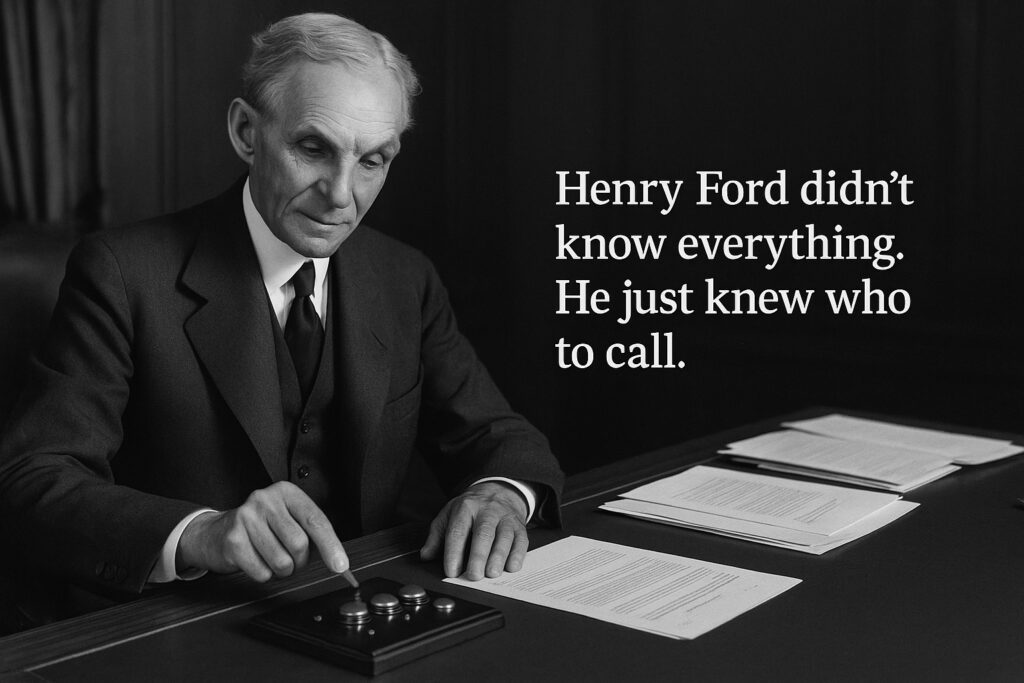
One of the most valuable lessons I drew from this book: you don’t need to know everything. You just need to know the people who know the things you don’t.
Napoleon Hill dedicates an entire chapter to the concept of the “Master Mind.” He’s not talking about networking – the kind where you go to events and swap business cards. He’s talking about a form of energetic resonance: when two or more minds align toward the same goal, they generate a third force that none of them possess individually. Hill also states plainly that no single person has enough experience, education, and ability to accumulate great wealth without the cooperation of others.
Sounds abstract. But I’ve experienced it firsthand.
When I started changing how I thought about money and freedom, something strange happened: I began meeting people I never imagined I’d share a table with. One ran a billion-dollar enterprise with tens of thousands of employees, yet still slept eight hours a night and quietly donated to charity without ever posting about it. Another slept in five countries across seven nights – not because work demanded it – simply because “it sounded fun.” Their lives were symphonies of passion and curiosity, and I sat there wondering: wait, you can actually design a life like this?
Henry Ford – one of the central figures in the book – once said he didn’t need to know every answer. He just needed to know where to find the people who had the answers.
And here’s the lesson I paid a steep price to learn: environment determines direction. Sit with certain people long enough and you’ll start thinking like them. Not because you’re weak or impressionable, but because the human mind naturally operates on resonance. Sit in a room full of complainers and eventually your own life will seem full of things to complain about. Sit with builders, creators, givers – and that energy seeps into you, quietly but powerfully.
I’m not saying you should drop all your old friends. I’m saying you should actively seek out new circles – groups of people who make you feel small but deeply hungry to grow. That feeling of being “a tiny seed planted in the richest intellectual soil” – that’s the highest-return investment you’ll ever make.
Decision and Persistence – Don’t Quit at the Last Meter
This is my favorite part of the book, because it strikes at the most common mistake almost everyone makes – myself included: quitting too soon.
Napoleon Hill compares persistence to carbon in steel. Iron is soft on its own, but add carbon and it becomes steel – harder, more durable, able to withstand pressure that iron simply can’t. Your life works the same way. Talent is iron. Persistence is carbon. Without persistence, talent remains nothing more than potential. Hill emphasizes that the difference between success and failure often comes down to whether you’re willing to take just one more step.
I remember the early days of building passive income. Month one: zero. Month two: still zero. Month three: a tiny amount – so small I was embarrassed to tell anyone. People around me kept asking: “Why are you wasting time on that stuff? Just pick up extra shifts – at least that’s guaranteed money.” And I almost listened. Almost.
But Thomas Edison – the man who failed 10,000 times before inventing the lightbulb – said something that Hill recorded in the book. He didn’t consider himself a failure. He simply found a very large number of ways that didn’t work. That single reframe completely changed how I looked at setbacks.
So I started applying one very simple principle: turn everything into a habit so it no longer requires “effort.” Running stopped being effort – it became a habit, like brushing my teeth. I don’t need “inspiration” to run. Five in the morning, shoes by the door, lace up, go. Done. Giving away books stopped being a “project” or a “charity initiative.” It became a quiet, repeating joy. Every time I came across a great book, my first reflex was: who might need this?
Knowledge kept inside your head is clutter. Shared with others, it becomes an asset. Take whatever’s useful here – save yourself from tripping into the same holes I fell into.
Decisiveness gave me the ability to start fast. Persistence kept me from turning back when the road was long, the night was dark, and the results were nowhere to be seen while the sweat was already pouring.
Conquering the Six Ghosts of Fear – Living at Ease
The final message – and the one that brought me the deepest sense of peace.
Napoleon Hill identifies six basic fears that hold people back: fear of poverty, fear of criticism, fear of illness, fear of losing love, fear of old age, and fear of death. Then he makes a powerful statement: fear is nothing but a state of mind, and states of mind can be controlled and directed.
I read that line the first time and nodded. Read it the second time and started thinking. Read it the third time and felt a jolt. Because I realized that for most of my life, I’d been letting fear sit in the driver’s seat. Fear of being judged for doing things “differently.” Fear of failing after stepping outside the comfort zone. Fear of losing stability – even though that stability was really just a beautifully decorated cage.
But when I started practicing – truly practicing, not just reading and forgetting – everything got lighter. I gave books to strangers. Some accepted them gratefully. Others looked at me like I’d lost my mind. There was a time when that look alone would’ve made me shrink. Now? I smile. Because when your mind is filled with purpose and a hunger to contribute, the fear of criticism has nowhere left to hide. It’s like switching on the light in a dark room – the darkness disappears on its own. You don’t have to chase it away.
Napoleon Hill insists that you have absolute control over exactly one thing – your own mind. And he calls that the most magnificent of all truths.
I completely agree.
When you take command of your mind, you live at ease. Not the lazy kind of ease, but the kind that stays calm in the middle of a storm. Variables still come – life always brings them – but you meet each one with curiosity instead of panic. “Hm, what’s the hidden lesson this time?” That’s the question of someone operating on a different level of awareness entirely.
Final Words
After finishing Think and Grow Rich, I didn’t become a billionaire. My bank account didn’t jump. And I don’t have a magic formula to share.
But I know one thing for certain: I’ll be fine, no matter what. Not because of blind optimism, but because I now hold the blueprint. I know I need desire to get started. Faith to keep the fire alive. The right people to create resonance. Persistence to not quit at the final meter. And mastery of my own mind to smile through every variable life throws my way.
Success – to me – is no longer the finish line measured in money. It’s the process of becoming a better version of yourself each day: healthier, wiser, and most importantly – more valuable to the people around you.
This life is yours. And you have every right to design it into a work of art worth living. Start with a burning desire. Nurture it with faith. Execute it alongside worthy companions. Persist to the end. And smile your way past every fear.
Ahaalife – A life worth living.