Finding light amid impermanence
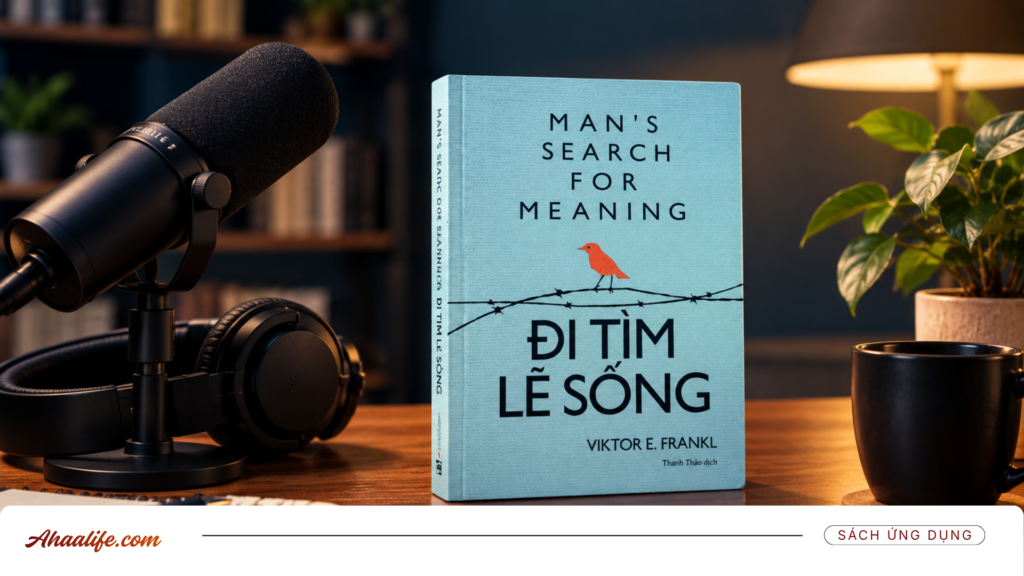
Some books we finish, return to the shelf, and quickly forget as time flows on. But there are works that, when the final page closes, open a vast stillness in our minds—compelling us to sit quietly, face ourselves, and reexamine the entire path we are walking. Viktor E. Frankl’s Man’s Search for Meaning is one such book.
It is not merely a historical memoir recounting a brutal genocide, nor is it a dogmatic self-help manual. Standing on the fragile threshold between life and death in a “hell on earth,” Frankl left behind an invaluable spiritual legacy: a revolution in how we perceive existence. Reading it, I realized that searching for life’s meaning is never about hunting for something pre-existing on the outside. It is a profound inner transformation—from demanding things from life to actively crafting a peaceful, worthwhile, and deeply meaningful existence.
Part 1: From the hell of auschwitz to gratitude for the present
Viktor Frankl endured humanity’s darkest hours in concentration camps, most notably Auschwitz. There, human beings were stripped of everything: identity, clothes, loved ones, status, and even the fundamental right to live as human beings. He synthesized prisoner psychology into three stages: initial shock and denial; apathy and numbness as a natural defense mechanism against daily cruelty; and finally, the bitterness and disorientation following liberation.
Yet the most precious insight Frankl observed at the edge of life and death was not physical collapse, but the miraculous power of the human spirit. Those who survived the biting cold, extreme hunger, and relentless beatings were not necessarily the physically strongest. They were those who held onto a reason to keep living—a promise to a loved one, an unfinished work, or an unshakeable faith in the future.
This truth struck my mind with immense force. Looking back at my own life, I realized that the crises, hardships, and dead ends I once faced were merely a fraction of what those in Auschwitz endured. We often tend to exaggerate our personal pain, magnifying minor unpleasantries into crushing burdens and sinking into self-pity.
Finishing the book, a wave of profound gratitude washed over me: endless gratitude for waking up each morning free to breathe, living in peace, and having enough food and clothing. When perspective shifts, the mind naturally releases petty worries. Complaints fade, replaced by full appreciation for every present moment.
Part 2: the “Existential vacuum” & Logotherapy
From these ordeal-tested experiences, Frankl founded Logotherapy. His core philosophy posits that humanity’s ultimate drive is neither the Will to Pleasure (as Sigmund Freud asserted) nor the Will to Power (as Alfred Adler contended), but the Will to Meaning. When people lose this drive, they fall into an “Existential Vacuum”—a feeling of emptiness, boredom, and aimlessness, even while living and working normally on the surface.
Honestly, I used to see myself entirely in that “vacuum.” Those were days spent living like a pre-programmed machine: going to work in the morning, returning home in the evening, working hard until payday, and getting caught in an endless loop of survival. I used to ask myself, “What does life bring to me?” only to receive a terrifying silence from my inner void.
Frankl’s Logotherapy appeared as a compass, completely reversing my mindset. I realized the right question is not what life brings to us, but “What do we bring to this life?”
This philosophy aligns perfectly with spiritual teacher Sadhguru’s perspective. He emphasized that while the external world may be completely beyond our control, our internal state remains entirely our choice. Our ability to respond to life is limitless. Applying Logotherapy, almost all my previous anxieties and worries dissolved. I understood that personal worth is not measured by what we accumulate, but by the meaning we create.
Upon discovering my purpose, my inner resolve awoke stronger than ever. Setting grand goals for my life, I look ahead at the path and know: no matter how tough it gets, it will never compare to the road walked by the people in Frankl’s account.
Part 3: From consciousness to action – the “Ahaalife” footprints
Frankl identified three paths to finding meaning in life:
- Through Creation and Work (Creating a work or completing a mission).
- Through Experience and Love (Experiencing beauty, nature, art, or deep human connections).
- Through Attitude toward Suffering (Choosing how to face adversity).
I chose to translate these realizations into concrete daily actions, starting from the smallest steps.
Ripples from Simple Acts
Every morning, I maintain a running routine. Rather than keeping this joy to myself, I capture those workout moments and send them to my younger siblings as a gentle nudge toward health and discipline. Seeing that energy, they moved from hesitation to enthusiastically joining running events, proudly hanging their medals at home as self-rewards. Seeing their positive transformation, I realize I am living meaningfully.
Establishing “Ahaalife.com” and the 1,000-Book Journey
To spread this philosophy further, I created the website Ahaalife.com—a space where I share reflections on life perspectives, offering a lens on “A Life Worth Living” so any visitor might find a moment of peace.
Alongside this, I embarked on a journey to promote reading culture. I have gifted over 200 books to my team and colleagues, setting a clear goal: to pass along more than 1,000 valuable books before closing my journey on this earth. Giving books is not just sharing knowledge; it is planting seeds of positive thinking in people’s souls.
A 6,000 km Cycling Journey in 80 Days Across Vietnam
To challenge my limits and inspire a vibrant life, I planned a 6,000 km cycling trip across Vietnam over 80 days. Simply hearing about this plan sparked excitement and positive energy in those around me. Through these actions, they began to believe that people can truly break free from rigid molds to achieve extraordinary, unique things in life.
Peace in Every Step
If Frankl teaches us to seek meaning in mission, Zen Master Thích Nhất Hạnh offers a delicate refinement: “There is no way to peace; peace is the way.”
I realized that life’s meaning or inner peace does not lie at the finish line of a 6,000 km trip, nor does it wait for the 1,000th book to be handed over. It resides in being fully present with every pedal stroke, every book gifted, and every running step under the sunrise. This is Peace in Action—committing and dedicating oneself fully without the weight of anxiety or the urge to compete.
Part 4: from anger to impermanence
In Frankl’s book, one detail embedded itself deeply in my mind, causing much reflection: the story of a sister who yelled at her little brother for not putting on his shoes fast enough during an evacuation in the freezing winter. Yet, in the chaotic evacuation that followed, the two siblings were separated forever.
When she realized those harsh words were the last she would ever say to her brother, the belated regret left a bleeding wound in her heart. She promised herself never to yell at anyone again, knowing it could be the last time she ever saw them. She chose to replace irritation with empathy and loving words.
This detail struck directly at my own hidden flaws. Truthfully, I am still an ordinary human, harboring moments of anger and dissatisfaction. Controlling anger and irritability has never been easy.
However, that story—combined with the philosophy of impermanence—became a wake-up call. Sadhguru bitterly likened it: “Anger is like drinking poison and expecting the other person to die.” Life is inherently too short and fragile. The line between presence and loss can hinge on a glance, a trip, or a single word.
Whenever anger arises, I ask myself: “If this were the last time I met this person, would I want to leave them with anger?”
The answer is always NO. Awareness of impermanence does not make us pessimistic; it makes us cherish one another more. To live a peaceful and fulfilling life, anger is never the solution. Instead, empathy, compassion, and sincere words of love are the only keys to healing wounds and connecting souls.
Conclusion: A Life Worth Living!
Man’s Search for Meaning is not just a book to read, but a path to live. Through the lens of Viktor Frankl, illuminated by the wisdom of Thích Nhất Hạnh and Sadhguru, I realized that life’s meaning is not something waiting passively for us to find; it is a masterpiece we actively carve out through our daily attitudes, choices, and actions.
We cannot choose the circumstances that happen to us, but we retain full freedom to choose how we respond. That is the ultimate human freedom—an inner freedom that no one and no adversity can ever strip away.
No matter who you are, where you are, or what challenges you face, remember that life is waiting for your response. Don’t ask what life brings to you; start by giving—give a smile, a loving word, a good book, or simply your full presence in this very moment. Because ultimately, a peaceful and worthwhile life is a life where we choose to live meaningfully every single day.