Have you ever asked yourself: Where does true happiness really lie in this life? It is an elusive question that most of us spend our youth, or perhaps even a lifetime, chasing blindly. We fall under the illusion that happiness is a destination, a reward waiting somewhere ahead—after we save enough money, buy our dream house, own a luxury item, or reach a certain social status.
I used to be someone drifting in such illusions. Back when I was young, just starting out at work and saving up enough to buy my first Nouvo motorcycle, I felt so “snobbish” and accomplished. I slapped the label of “happiness” onto that moment. But the bitter truth was that this feeling of triumph lasted for less than a week. Later on, each time I upgraded to the latest smartphone, the excitement wouldn’t last more than 10 days before slipping back into a numb, ordinary state.
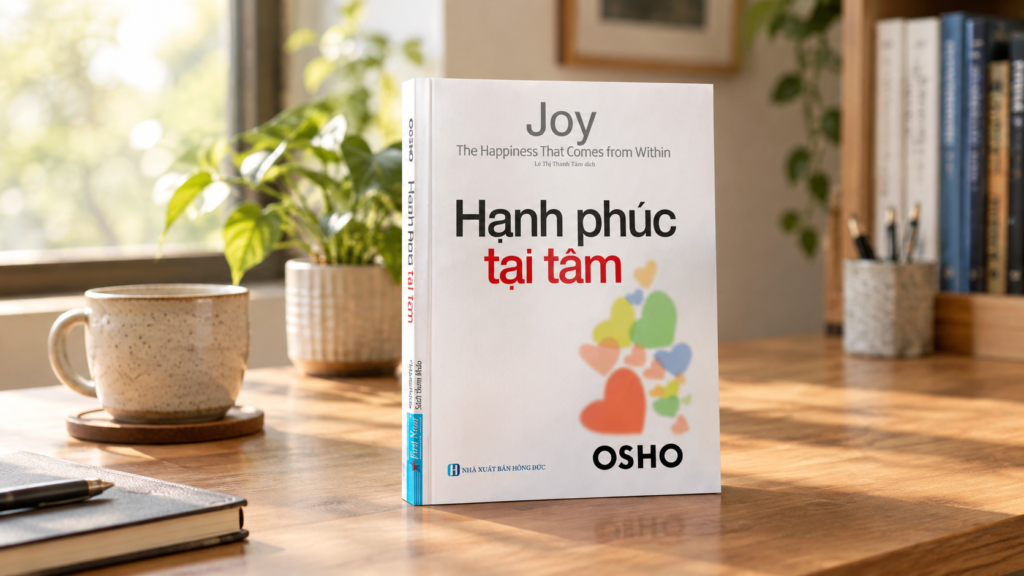
It wasn’t until I held Osho’s book Joy: The Happiness That Comes from Within (Hạnh Phúc Tại Tâm) in my hands that I suddenly woke up and realized: What I had been chasing frantically all those years was merely Pleasure—short-term sensory stimuli—or, a bit higher, Happiness of conditions (conditional happiness)—a fragile kind of happiness entirely dependent on external circumstances. Meanwhile, Joy (inner peace untroubled by external storms) remained so rare. Observing the world around me, I realized that most people are also trapped in that same cycle: frantically seeking temporary pleasure while forgetting the true source of inner peace right within themselves.
Are we “living” or just “surviving”?
During a business trip to India, I had the opportunity to share a vegetarian meal with a local colleague at a local restaurant. In that serene space, he told me a story about a strange village.
In that village, there was a cemetery where the number of years lived was carved onto the headstones. The strange thing was that most of those numbers were only 7, 9, or at most 10 years. Passersby seeing this were shocked, assuming that some terrible natural disaster or plague had claimed the lives of the children in the village. Noticing the confusion, the villagers calmly explained: In reality, the average life expectancy of the people here is over 70 years. But those numbers on the headstones stem from the teaching of a wandering master who once visited the village. The master instructed everyone to carry a small notebook; every day, only if they truly felt complete and conscious happiness would they make a mark in it. When they closed their eyes for the last time, the total number of marked days would be converted into the actual years of “living” to be carved onto their headstone.
And the result was staggering: Looking back at a lifetime spanning more than seventy years, the number of days they truly “lived” accounted for less than 10%.
“Don’t just survive. Live. Life is a gift, not an obligation.” — Osho
That story made me startle and look back at myself. Was I also living a mindless life, spending 90% of my time just “surviving”? In Joy, Osho pointed out a chronic human malady: We spend too much time chewing on the past that has passed or worrying about a future that hasn’t arrived. We turn ourselves into “beggars of happiness”—waiting until we have more money, waiting for a stable job with a high salary, waiting for our children to graduate… We postpone the peace of the present moment to wait for an uncertain future. But by placing the key to happiness in the hands of circumstances or others, we turn ourselves into slaves of expectation and disappointment. Inner peace does not lie in the future; it exists only Here and Now.
Two sides of the coin: Embracing suffering to touch inner peace
Reading Osho helped me heal how I perceive time and past wounds.
I understand that the pains of the past belong to yesterday. They can become a beautiful memory, a story to tell with understanding, or simply left to sleep beneath the dust of time. As for the future, I still plan out my finances and train my body every day with absolute seriousness and responsibility. But the final outcome, I learn to leave to “Heaven”—to the natural laws of the universe. I know I cannot dictate the future; the only thing I can do is to do my best with what is needed in the present and gracefully accept whatever happens.
In his book Courage, Osho emphasized that walking through life requires the bravery to open one’s heart to all experiences. And in Joy, he offers a profound philosophy: “When you do not accept suffering, that is also the moment you refuse happiness.”
Pain and joy are two sides of the same coin. Avoiding sadness means you are voluntarily slamming the door shut on joy. Life is not a perfect straight line. If you strain yourself to run away from the low notes, rejecting disappointment or sorrow, you will also unintentionally deaden your ability to feel bliss. When we accept that sorrow is a natural part of life, we are no longer crushed by it. We calmly watch it come and go, like passing clouds across a clear sky.
Living through office storms with a leisurely mindset
Osho’s philosophy is not some “up in the clouds” philosophy meant for escaping reality. It is a guiding lamp that helps me maintain inner peace right in the middle of a bustling corporate life.
Every day walking into the workplace, I do not delusionally expect my surroundings to always be smooth like a flat ribbon of silk. In reality, office life is still full of conflicts, deadline pressures, uncontrollable twists and turns, and tense relationships—where there are people you feel like every time you meet them, you’re ready to “throw grenades” at each other.
But now, I step into that space with a completely different mindset. I understand and accept that as an inevitable part of the “rules of life.”
I realize that deep down, most people want to contribute something good and prove their worth when coming to work. It’s just that everyone expresses it differently and hasn’t yet found the intersecting point to touch harmony. Heated, fierce debates are sometimes the necessary friction to spark fresh ideas for the organization.
Even when having to part ways with a colleague because they no longer fit our shared path, I no longer feel heavy or resentful. On the day they leave, I always send them a sincere wish: “No matter where, you will eventually find a place of inner peace where your talents can shine brightest.” Osho’s book has imbued me with that leisurely spirit—an inner composure that helps me stand firm amidst stormy debates without getting swept away by anger or resentment.
The essence of Meditation: Returning to the original Zero
Osho is a master of meditation, but his perspective on meditation is always frank and demystifies all preconceptions.
Many people often mistake meditation for a method to achieve something—to attain relaxation, elevate consciousness, or reach high spiritual “levels.” If you hear advertisements somewhere claiming that following a certain meditation course will grant you this ability or that level, from Osho’s perspective, that is a complete distortion. That is merely human greed dressed up in spiritual clothing.
Meditation is not about achieving anything at all. Meditation is about letting go. Meditation brings a person back to the number ZERO (Nothingness)—back to complete stillness.
In his classic work The Book of Secrets, Osho points out that meditation is simply the art of non-judgmental observation. Meditation helps you let go of worries, not responsibilities toward life.
From a scientific perspective, on average, the human brain emits over 6,000 thoughts every day. Every 10 seconds, a new stream of thought emerges. That is why the brain, even though it accounts for only about 2% of body weight, consumes more than 20% of total energy. We are always in a state of exhaustion because of the “background apps” running in our minds.
Meditation is precisely the act of turning off those junk apps. When you practice observing your mind without getting carried away by it, the wasted energy is gradually eliminated. And when the body’s energy is conserved, a natural, fresh sense of peace will automatically envelop your entire body and mind.
Happiness is a journey of returning
Going through the pages of Osho and reflecting on my own journey, I realize that the answer to the question “When is happiness?” has never lain in the past or the future, nor has it ever been far away on the outside.
Happiness does not lie in a new motorbike, the latest smartphone model, a distant future when we save up enough money, nor does it lie in mystical “meditation levels” detached from reality.
True happiness is when we stop being a “beggar,” when we stop waiting for circumstances to change. It is the ability to calmly smile and welcome both the sunshine and the rain of life right in the present moment. Thanks to this perspective, each passing day is no longer a tiring existence for me, but a day truly “lived”—a day worthy of being marked in the notebook of my life. May you, whether amidst work pressures or life’s fluctuations, find a quiet moment to let go of worries, return to yourself, and realize: The source of inner peace has always been there, right at your heart, right at this moment.