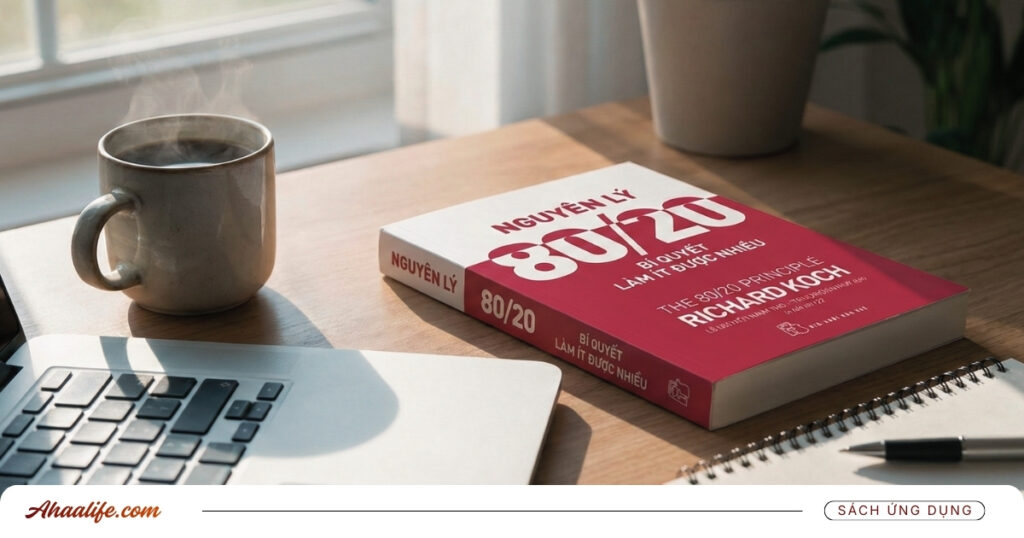
In his world-renowned book, Richard Koch dropped a bombshell: “Most of what we do is of little value.”
The world is inherently unbalanced. This imbalance isn’t a flaw of nature; it’s a universal law present in every corner of life—from economics and business to personal happiness. I once spent half my life fighting this law, trying to be “everything to everyone,” only to realize I was squandering my most precious asset: My life.
I. My Old Self: The Chaos of the “Trivial Many”
Richard Koch refers to the 80% of things that yield little value as the “Trivial Many.” Looking back, I was a devoted slave to that “Many.”
1. Work: The Trap of Fake Busyness
I used to pride myself on being a “Workaholic.” I was the first in the office and the last to leave. But Koch’s book felt like a cold splash of water to the face when it revealed: 80% of our time contributes to only 20% of our results.
I spent 80% of my time in what Koch calls the “low-productivity zone”: compulsively checking emails, drifting through meetings with vague agendas, or obsessing over minor formatting in reports instead of focusing on strategic content. I thought I was working, but I was merely “moving” in place. The result? Work remained unfinished, and I was constantly missing deadlines for the things that actually mattered.
2. The Mind: Wasting Energy on Past and Future
In the 80/20 principle, your mindset is your greatest asset. Yet, 80% of my thoughts back then were “spiritual waste.”
- The Past: I spent massive energy replaying past mistakes. Koch emphasizes that we cannot change what has happened, yet we tend to waste enormous mental resources on these “zero-return” activities.
- The Future: I worried about “worst-case scenarios,” most of which never came to pass. Through this book, I realized that 80% of anxiety yields 0% real value; instead, it suffocates 80% of my current creativity.
3. Relationships: Negative Resonance
Koch writes: “Good relationships are the highest-return resource for happiness.” Yet, I used to “carpet-bomb” my investments.
I had thousands of “friends” on social media and hundreds of contacts in my phone. But when I faced true hardship, 80% of those connections vanished like soap bubbles. Worse, I gave 80% of my time to “energy vampires”—people who only complained, felt envious, or dragged me into mindless distractions. I had ignored the law: 80% of our peace and joy comes from just 20% of the people who truly love and understand us.
4. Clutter and the Burden of Possession
Applying the Pareto principle to my old home revealed an economic disaster. According to Koch, we typically use only about 20% of our living space and 20% of our belongings for 80% of our daily lives.
My house was filled with exercise machines used as clothes racks, dinnerware sets used once a year, and a closet so packed I’d still wake up complaining I had “nothing to wear.” I was wasting my hard-earned money to buy 80% clutter, making my mind feel as cramped and suffocated as my room.
II. The Turning Point: Thinking 80/20
The shift began when I accepted a harsh truth: Doing less isn’t laziness; it’s intelligence. Richard Koch guides us through two steps: 80/20 Analysis and 80/20 Thinking. I started looking at my life like an investor. I asked myself: “Which activities bring me 80% of my happiness? Which people bring me 80% of my peace?”
III. My Present Self: Living the “Vital Few”
By strictly applying Koch’s philosophy, I revolutionized my life.
1. Work: Focus on the “Diamond Island”
Instead of trying to do everything, I identified the 20% of key tasks that drive revenue and recognition. I call this my “Diamond Island.”
- I dedicate the first 4 hours of my day (peak energy) to the single most important task.
- I learned to say “No” to unnecessary meetings.
- I delegate or ignore the trivial details.
The results were staggering: I work fewer hours, yet my income and professional growth have soared. I no longer chase work; I command it.
2. Relationships: Quality Over Quantity
I implemented the “Rose Garden Pruning” strategy Koch suggested. I focus 80% of my emotional resources on the 20% of people who matter most: my family, my soulmates, and my sincere partners.
Peace comes from knowing you don’t need to please everyone. A narrow but deep circle provides stronger psychological support than a vast, shallow network.
3. Minimalism for Freedom
I purged 80% of the items in my home. The 80/20 rule taught me that owning fewer things means having more space for thought.
Now, I only keep what is truly necessary or truly sparks joy. With fewer possessions, cleaning disappears, the anxiety of maintenance disappears, and I realize I have more time to walk, to read, and to truly live.
4. Sleep and Letting Go
Before bed, I apply the “20 Golden Minutes.” Instead of letting 80% of random thoughts take over, I spend 20 minutes practicing gratitude and listing the 3 most important things for tomorrow. When the mind is programmed to focus on the positive, sleep becomes deeper and far more restorative.
IV. Finally: A Life of Freedom and Impact
Living by the 80/20 rule doesn’t mean becoming selfish or lazy. It means becoming more responsible for your own life.
Richard Koch wrote: “We can achieve more by doing less.” This isn’t a hollow slogan; it’s a mathematical formula for happiness. When you have the courage to cut out the 80% of noise, you will finally hear the voice of the 20% of truth.
The “Me” of today is no longer busy. I am unrestrained.
- I am free because I know what to do and what to let go.
- I am free because my mind is no longer a landfill for the past or fears of the future.
- I am free because I am surrounded by kind people and healthy interactions.
Life is too short to waste on the trivial. Have the courage to drop the unnecessary burdens, focus on your core values, and you will find yourself not just more productive, but truly “alive” in every moment.
The Lesson: The 80/20 rule is a master key. Are you ready to “discard” the 80% holding you back to reach the 20% peak of happiness?