For 12 years working at a multinational corporation, I lived like a spinning top — constantly proud of my packed schedule and a phone that never stopped buzzing. I used to wear busyness like a badge of honor, proof of my worth within the system.
Then one morning in Chennai, India, a single sentence from an old colleague shattered that illusion entirely — and forced me to rethink everything I believed about work, productivity, and how to actually live.
1. Suwon – Where Soju Opened My Eyes to a New World
It all started years earlier at our office in Suwon, South Korea. Those were the days I immersed myself in the “Palli-Palli” culture — the quintessential Korean “hurry, hurry” mindset that pulses through every corner of that country. My desk neighbor was a Korean engineer, and although we worked in completely different functions, the proximity turned us into unlikely after-work companions.
South Korea, to my eyes back then, was a colossal machine running with breathtaking precision. Through those evenings after work, he introduced me to the world of “Hwesik” — the company dining ritual that is as much about hierarchy as it is about food. He taught me the proper way to pour Soju: hold the bottle with both hands, the younger always pours for the elder, and never — under any circumstance — let the glass across from you sit empty. Over sizzling charcoal grills and thick clouds of smoke, he walked me through the unspoken rules of Korean business culture: the rigid hierarchy, the pressure of the system, and the careful, deliberate way trust is built before a multimillion-dollar contract is ever signed.
I looked at him and our Korean colleagues with pure admiration. They worked as if tomorrow might never come — and played with the same ferocity. I told myself that this relentless busyness was the secret behind the “Miracle on the Han River.”
2. Reunion at the “Automobile Capital” of South Asia
Five years after leaving Korea and returning to Vietnam, our connection slowly faded. Until one day, a business trip brought me to Chennai, India — famously known as the “Detroit of South Asia.” My old friend had risen to a senior management role, overseeing a division of more than 100 engineers and managers within a factory of 4,000 people.
The factory was vast. Every morning, streams of workers poured into the workshops like columns of ants. At that scale, it was entirely normal that I’d been there three days without him knowing. I wanted to surprise him, so I quietly went about my work with his middle managers, saying nothing.
Throughout those first few days, I’d occasionally walk past the main office area. From a distance, I could still make out his familiar silhouette — and he looked incredibly busy. One moment he’d be standing in the middle of a heated debate among engineers; the next, buried under stacks of technical drawings with a deeply stressed expression on his face. I thought to myself: “The higher you climb, the heavier the load. He’s still running at full Korean speed.”
On the morning of the third day, once my own work was mostly wrapped up, I walked straight to his desk just as he put down his phone. I greeted him in Korean: “An-nyong Ha Se Yo!”
He froze. His eyes went wide, like he’d seen a ghost. Then he burst out laughing, questions tumbling out all at once: “When did you get here? Why didn’t you tell me? Are you free tonight — we have to get dinner!” True to Korean instinct, dinner always comes first.
3. Faking Busyness
That evening, in a quiet space far from the noise of the factory floor, I told him: “I actually spotted you a few days ago — but you looked so swamped with hundreds of people around you, I didn’t want to interrupt.”
He took a slow sip of tea, looked at me with calm, knowing eyes, and said something I wasn’t prepared for:
“There’s not much to do, honestly. The truth is — everyone here is just pretending to be busy.”
That sentence hit me like a cold splash of water. A senior manager overseeing hundreds of people, inside a factory of thousands, openly admitting it was all just… performance? He continued:
“Every job here already has a process. The system was designed to run like a well-oiled machine. If everything goes according to plan, I genuinely have nothing to do. But the organizational culture doesn’t allow for ‘doing nothing.’ So people manufacture the appearance of busyness — either to feel relevant, or to mask the inconvenient truth that the system isn’t actually efficient.”
Then he made two points I haven’t stopped thinking about since:
First — Problems only arise when something changes: Real busyness only appears when unexpected variables enter the picture — whether it’s a necessary change you’re driving, or an unplanned crisis landing on your desk. If you’re perpetually busy, it means you’ve lost control of those variables, not that you’re doing great work.
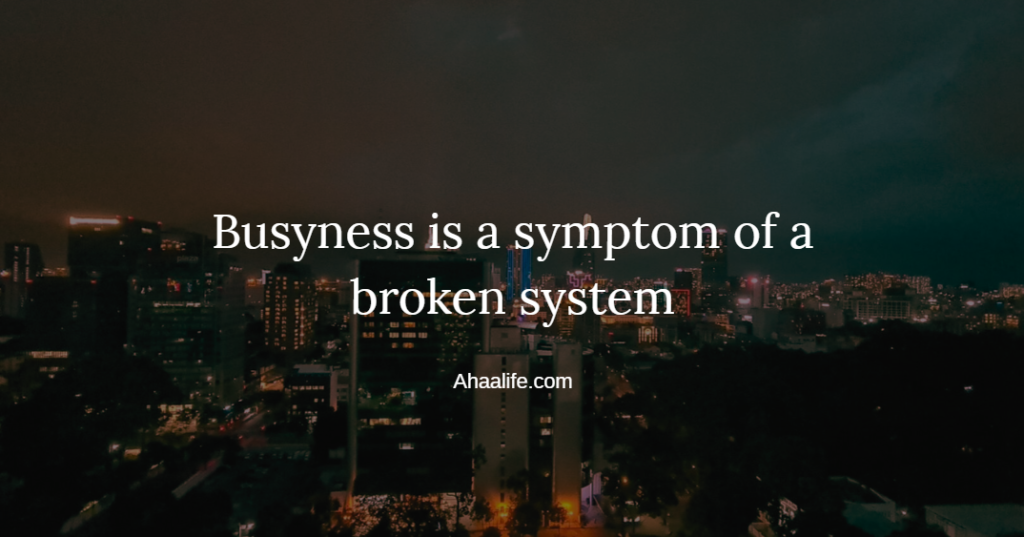
Second — Busyness is a symptom of a broken system: The best manager in any room is often the one who looks the most relaxed — because they’ve built systems that run without requiring their constant intervention.
4. The Philosophy of True Effectiveness
His words brought to mind the thinking of some of history’s greatest industrialists.
Henry Ford — the father of the modern assembly line — once said: “Being busy is not always real work. The question is not how busy you are, but what you are busy about.” Ford understood that if workers were frantically running back and forth across the factory floor, it meant his process was broken. True efficiency meant each person standing in one place, optimizing every small movement, so the product could flow on its own.
Then there’s Chung Ju-yung — the founder of Hyundai, and an icon of the Korean entrepreneurial spirit. He’s famous for his relentless drive, captured in his signature challenge: “Have you tried?” But beneath that push was a deep commitment to systems thinking. For him, busyness without improvement or breakthrough was simply a waste of life’s resources. An organization where everyone is perpetually overwhelmed is usually one without a real plan — where people substitute hard physical effort for the strategic thinking they never developed.
5. Designing a Life Worth Living
But the lesson from Chennai doesn’t stop at the factory gate. Looking at my own life honestly, I realized I had been faking busyness with myself for years.
We scroll social media for hours and call it “staying connected.” We show up to parties that bring us no joy and call it “networking.” We lie awake worrying about things that haven’t happened and call it “being responsible.” But the reality, as my Korean friend so plainly put it: we’re busy because we have no system for ourselves.
Without a clear life plan, we become permanently reactive — pulled in every direction by external noise. A spam notification. A request from someone else. A minor inconvenience on the road. Any of it can turn us into lifetime firefighters, running from one small blaze to the next, ending each day exhausted but no closer to anything that actually matters.
Most of the busyness we carry around is unnecessary. If we’re honest enough to face that, and willing to plan our lives just a little more deliberately — we’d discover we have far more time than we think.
That reclaimed time isn’t meant for more pretending. It’s for the things that genuinely move us: miles run at dawn, a new song learned on the piano, or simply sitting still long enough to look inward.
The lesson from Chennai is this: Don’t let the noise of activity fool you into thinking you’re living with purpose. Stop performing. Take back control. And use the time you’ve freed to design a life that’s actually worth living.